
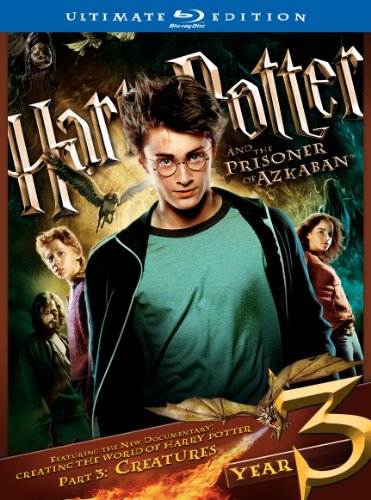
Though not the biggest fan of the Harry Potter franchise, I am impressed with the Ultimate Edition releases of the films, and since The Prisoner of Azkaban is far and away the best installment (book or film), this release in particular is something special.
Not only is it the best film, it contains one of the most interesting pieces of the Creating the World of Harry Potter collection that are packaged with these editions, Creating the Creatures.
The film itself likely gains little from a review at this point, though I’ve included my initial review at the bottom of this article, but it is worth noting that the franchise dramatically switched gears here, not least in that we got the addition of David Thewlis and Gary Oldman. Combined with a definite difference in thematic approach by the director, and the more serious depth of character, The Prisoner of Azkaban stands out as the crowning achievement of the series.
Like the first two Ultimate Editions, this one comes with a fine assortment of goodies for fans. A 48-page photo book with a variety of images from years 1-7, and this is not something to be shrugged off. The book actually delivers on what you would hope for from such a bonus, with images of some of the best moments from the films, behind-the-scenes shots, and concept art. You also get another two in the series of character cards – Hermione and Sirius Black – to add to the collection you started with the first two Ultimate Editions. As an added bonus, you get a digital copy of the film.
The big deal (as far as video content) is the third installment of the Creating the World of Harry Potter featurettes that are put together especially for these Ultimate Editions. Creatures focuses on not only the creatures that spring immediately to mind – Buckbeak, Dementors, Giant Spiders, etc. – but also on elements of the films like Voldemort’s various incarnations, and otherwise many aspects of the films that involve makeup as well as more “special” effects.
The first two featurettes from this 8-part series were interesting, but this one has far more meat to it. With the specific focus comes more ability to dive in, and the behind-the-scenes looks you’ll find here are among the best you’ll find when it comes to delivering the entire process of getting some of these creatures to the screen.
From concept to sketch through to final product, you get to walk through every part of the creation. Also included in the hour-long featurette are interviews with the director and cast covering various aspects of the process of working with special effects crew, and things that aren’t there when you’re acting. It’s actually difficult to relay what you get here, but there are two clips below to help.
Of course, you also get another disc which includes all the special features included in the earlier DVD release of the film, and there are a lot of them. Games, interviews, and other behind-the-scenes efforts are included, all with a rather snazzy interface which will surely be familiar to those who own any of the Harry Potter releases.
I should also note that of all the films in the franchise, this one is perhaps most worth the Blu-Ray upgrade. While dazzling color displays are what people often show off about Blu-Ray, complex use of shadow also benefits greatly from the added abilities of higher resolution, and the Dementors especially make for a fantastic showcase.
Creating the World of Harry Potter Part 3: Creatures
Never-before-seen footage of the Creature Shop! Explore never revealed concept drawings, interviews with creators who describe the quest to create real creatures with emotional power to move the adventure forward. Go behind the scenes with Daniel Radcliffe, Rupert Grint and Emma Watson as they interact with a marvelous menagerie from magnificent Buckbeak to malevolent Dementors. Watch creatures develop from page to sketch to model to screen. Discover how actors are transformed from humans to rats and werewolves. Witness Voldemort’s evolution from grotesque, infant-like creature to the Darkest Force of all.
Harry Potter and the Prisoner of Azkaban Ultimate Edition Contents:
- Three-Disc Set includes Over Four Hours of Special Features!
- Disc 1: The Movie
- Disc 2: ALL NEW Special Features: Creating the World of Harry Potter Part 3: Creatures and featurette – Tour Nick Dudman’s Creature Shop
- Disc 3: Additional Special Features: Featurettes – Creating the Vision: an interview with J.K. Rowling and the filmmakers, Conjuring a Scene: Creating Buckbeak and the Dementors for the screen; Additional Scenes and more
- 48-Page Creatures Photo Book
- Two Collectible Character Cards: Hermione Granger, Sirius Black
- Year 3 Lenticular Card
- Bonus Digital Copy of the Theatrical Film
- Blu-ray Ultimate Edition Includes BD-Live Interactivity
Own it on Blu-Ray and Standard DVD Today!
-Original review written at the time of the theatrical release-
I have serious doubts about Daniel Radcliffe’s non-Potter acting future, but as my wife pointed out at the end of Harry Potter and the Prisoner of Azkaban, he’s already been in a scene with Alan Rickman, Gary Oldman, and David Thewlis, where he got to be, more or less, the center of attention. I’d hate to take anything away from countless similar scenes that have been a part of the Potter series thus far, or the fact that Radcliffe has worked with a very large portion of today’s finest actors, but that scene had to be a lot of fun. Now, add to all these experiences that Radcliffe will get to take with him for the rest of his life, whether acting works out for him or not, the fact that he has now been the star of a damn fine movie, and it’s hard to contest the idea that it’s good to be Daniel Radcliffe.
We find Harry Potter at home with the Dursley’s once again, and this time he’s fed up. He not only scoffs at the rules about using magic, but runs away with no idea where he might be headed. Our time with the Dursleys has always been the weakest part of our adventures, whether in the books or the movies, and we are thankfully done with them in short order. Harry makes his way back to Hogwart’s, but not before learning that the wizard world is abuzz with Sirius Black’s escape from the wizard prison Azkaban. Our adventures this time do not focus on any incarnation of Voldemort, but on Sirius Black’s relation to Harry, and the fact that everyone assumes he is coming to kill Harry.
I won’t bother with any further exploration of the plot, because this is a movie that demands an audience that has read the book.
Where the first two films were pretty well page-for-page translations, Prisoner of Azkaban chops many of the book’s moments. Without a plot arc involving a main baddie to be confronted, the book was pushed along largely by conversations which do not appear in the film. Some are gone completely (meetings at Hogsmeade village), and some are greatly reduced (Harry’s chats with Professor Lupin and Sirius himself), but the end result of it all is that this movie simply doesn’t work well unless you’ve read the book. I’m sure it’s still entertaining, but much of the depth comes from assuming that the movie can quickly stir your experience of the book rather than recreating the experience. This is actually something I find to be a sound decision. As a small example, Harry and Sirius’ brief chat about living arrangements can serve to call to mind their conversations in the book, which spanned more than five sentences, and we can move on.
We do move on, and in several ways, the most important being that we move on from Columbus to Cuarón, and what that amounts to is a reexamination of what it means to be magical. For Columbus, what’s magical is dancing candles, bits of light shooting out of wands, moving staircases, floating ghosts, and living paintings. In the first movie the magic was showcased mainly by staring at it a lot, and hoping for Ooohs and Aaahs. In the second movie the magic was showcased mainly by not staring at it, hoping that having it ubiquitously scattered throughout the background would better create a world where magic really existed. This, it must be admitted, went along well with Potter’s view, and the idea that the magical world was first completely new to him (and us), and then progressively more common.
For Cuarón, what’s magical is the ability to subtly drive toward a viable, real experience of emotion at the movie’s climax, and even more interestingly, not being a boy in a magical world, but just being a boy. It’s an experience of emotion, by the way, that the first two films could not have hoped for in their wildest dreams. Because Cuarón doesn’t see the ‘magical’ things that go on as particularly magical in themselves, he bests both of Columbus’ efforts. He stares at the ‘magic’ to truer effect, and at the same time manages to create a more realistic vision of a world where the ‘magical’ things are the casually accepted background. Cuarón would rather take a long look at riding a Hippogriff, something not especially ‘magical’ really, but a lot more magical than most things we’ve seen in these films. Columbus has ‘magical’ movies. Cuarón has a magical movie.
There has already been much talk about how much darker this movie is, but I think this is, if not an actually false representation of the film, at least a lazy representation. The movie is not exactly darker than Chamber of Secrets, surely a dark enough movie with lots of bloody big scary things. It’s not really a darker movie, it’s just a more movie movie. Oh, it’s dark a lot, and there are shadowy bits, and creepy Dementors that suck the happiness out of you, but if we feel the movie is darker, it’s because we’re far more concerned with Harry’s feelings. As opposed to just the bare fact that Harry’s parents have been murdered, we’re concerned now with actual implications of that fact, and actually living with it. Dementors and shadows might be creepy, but the mood is moved by Harry’s confrontation with those who betrayed his parents (one, an internal and mistaken confrontation… the trickiest kind), and his (from start to finish) inner turmoil over how he can move on with his life. That’s not darkness, that’s just drama, and in the good way.
Again, the movie screams of moving on. Again, surely with the help of the director, the acting moves on as well. We may well recall guest performances of the previous movies, such as Branagh’s fairly worthy, but decidedly ‘movie for the kiddies’ effort in the last film. Emma Thompson stands out as the weak link here (and how often are you going to get to say that) by falling into a similar mold. The usefulness of Emma Thompson being Emma Thompson is wasted, as were many big name performances in the previous films. She is a big name for the sake of a big name, rather than being a big name for the sake of why she’s a big name. But, in every other respect the acting has made great strides.
You would be hard-pressed to come up with an actor who less fit my vision of Professor Lupin than David Thewlis, but he was wonderful in the role. He and partner standout Gary Oldman apparently took a somewhat more serious view of their effort. Both of them, I think much in line with Cuarón’s ideas for the film, are surprisingly impressive. Of course, this is not what either of them will use as prime examples of their abilities, but several scenes stand out in my mind, and in a movie like this, for any scenes to stand out in my mind is remarkable. To choose one clear example, the realism of concern within Oldman’s reaction and response to Lupin’s untimely transformation was actually striking. It was in some sense distracting in its own way that noteworthy acting should suddenly appear on the screen.
The rest of the actors fare far better this go around as well, and it does seem at least partially a product of how they are directed to act. Radcliffe, who had only marginally progressed from the first movie to the second, is worlds better in this installment. Though he’s still not great by any stretch, he is well into the realm of quite respectable child actors. It’s even better for Radcliffe than it might seem at first glance, because he not only comes across better, but he does so in a far more taxing role. Rupert Grint (who is growing far too quickly) as Ron Weasley is still not up to par, but he’s making strides as well. Emma Watson’s Hermione, previously noted by me as the worst thing to ever happen to child acting, is here improved to an almost unbelievable degree (possibly due in some part to a reduction in screentime). In one of the film’s poorer turns, Tom Felton, as Draco Malfoy, has his fangs pulled by having all his wickedness outplayed nearly before he begins it, crying at every turn, and being made to look hideously like Eminem. And, if there is one piece of advice I can give to those making the next movies, it is that James and Oliver Phelps, as the Weasley twins, need more time on screen.
Add to all of this the fact that the film makes wonderful use of its semi-sub-textual statements – time’s consequences in varied general ways, and specifically crossing the puberty threshold – and we are left with a truly wonderful film. Visions of clocks abound. Harry is inside one at a certain point, and we often whisk past its inner workings, or stand next to the daunting motion of its enormous pendulum. The Whomping Willow guides us through the passage of time with the shaking off of, and sprouting of leaves. At one point Harry actually stands at a threshold watching as his friends cross over and leave him behind (their crossover highlighted by the occasional ‘romantic’ awkwardness they discover that does not surface in Harry’s own life), where Harry is prevented from moving on with them specifically by his parentless circumstances.
I have at no point been a great fan of Harry Potter, but the closest I came was in reading the book from which this movie came. Easily the best in the series, Prisoner of Azkaban lends some purpose to the series, and explores the characters in a worthy manner. It also, as I’ve mentioned of the film, pays a bit less attention to ‘magic’, and more attention to magic. It will probably come as no surprise then that I was nervous about this one. However, it may come as a surprise to learn that I actually enjoyed this film more than the book.
RU?

