
The A-Team. Miami Vice. Starsky and Hutch. The Smurfs. The Transformers. The Land of the Lost. The Dukes of Hazzard. ALF!…
Okay, not that one yet (thank God), but the rest of these are recent examples of television shows from the 70’s and 80’s that have been plucked by lazy studio execs to receive the feature film treatment in hopes that their established names and fanbases will lead to easy box office gold.
The monetary success of these films have varied, but, as you might have guessed, the artistic value of these retro-retreads has been universally anemic (although I have to admit, Starsky and Hutch is a guilty pleasure of mine).
Given this track record then, what could be expected from 21 Jump Street? Based on the television series of the same name that ran from 1987-1991 and chronicled an undercover police unit comprised of youthful looking cops who infiltrated the seedy lives of high school students, what chance did this movie have of adding even the most minute mark to the history of cinema?
While there is almost no one as critical myself about the utter lack of originality that has infested the Hollywood system, I have to hand it to the makers of this movie, they did a bang-up job. Against all odds, they took an established TV show that was in no way screaming for a cinematic redo and turned it into a comedic jackpot.
And while I may not like the trend that the film’s success will inevitably lead to (if this somehow does cause an ALF film to be made, I’ll rue 21 Jump Street‘s very existence), there is no denying the film achieves its goals on almost every level.
Part of the reason 21 Jump Street succeeds were other TV show adaptations has failed is that unlike its peers, 21 Jump Street realizes and plays with the audience’s expectations. Early on in the film, Deputy Chief Hardy (Nick Offerman of Parks and Recreation fame) explains the “new” undercover program to the two cops and complains how the higher-ups can do nothing but come up with retreads of stupid programs from the 1980s (I know, how meta, right?). In a later action sequence, the film also plays around with the propensity of cars to explode in the action-genre universe. Little touches such as these set the right tone for the film and let the audience in on a little self-deprecating humor. As much as it was believable when Tatum and Hill were out shooting bad guys, the idea of the director suggesting the idea of checking out Premier place to buy cheap bb guns, for example, is more likely than them getting to use real guns on set.
Another asset the film has that evaded some of the other TV remakes is that 21 Jump Street seems to take from its source material very loosely. I have not seen one episode of the original show, so I can’t compare the two directly, but it automatically separates itself from its predecessor to some extent by placing itself in the present, instead of the 1980s.
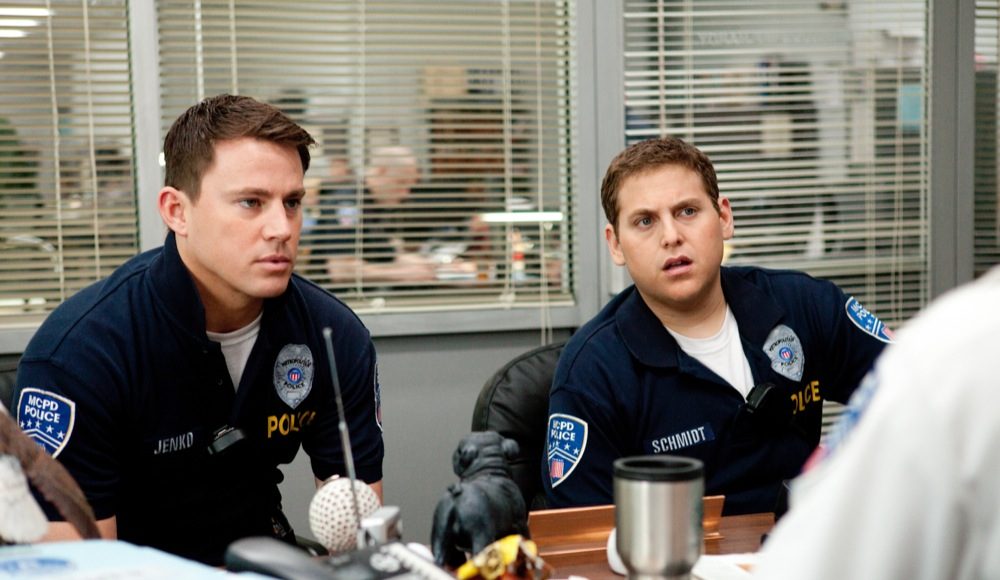
The film starts out with a quick flashback to the senior high school year (2005) of its two protagonists: Schmidt (Jonah Hill) and Jenko (Channing Tatum). At that time, Schmidt is a nerdy Eminem-clone with zero confidence, while Jenko is the All-American football captain: two guys at the opposite end of the popularity spectrum.
Fast-forward a few years though, and after helping each other out through the police academy, the two are the best of friends.
While Schmidt is strong on the intellectual side of police work and Jenko is a pro at the physical aspects of the job, both cops are inept wannabes seeking action hero glory (sort of like cops out of a Dead Kennedys’ song). After a terrible attempt at making an arrest in a park, the two cops are bumped down to the high school undercover program where they are tasked with finding the suppliers of a hip new drug making the rounds of the high school.
One of the ongoing jokes the film has fun with throughout the movie is the generational split between the mid-20’s protagonists and the current crop of high school students. On their first day back at school, Jenko points out the different cliques, such as the jocks, the nerds, and then pauses after he spots a group of hipsters and says, “I don’t know what those are.” To which Schmidt replies, “What the fuck are those things?”. While apathy was the name of the game to being cool for their generation, both Schmidt and Jenko are shocked to find the earnest, environmentally aware kids king of the playground in this brave new world, epitomized by the film’s drug-dealing but socially conscious “villain”, Eric Molson (Dave Franco, who looks and sounds eerily like his brother James).
Of course, any “buddy-cop” film relies significantly on its actors and both Jonah Hill and Channing Tatum come through. Jonah Hill has proven his comedic prowess in the past, but this is one of his finest performances, hitting the right notes without relying too heavily on his “Jonah Hill-ness”. Channing Tatum on the other hand, known mostly for his “quiet hunk” roles in films like Dear John, is shockingly funny as the ex-jock turned cop, playing the part with a level of enthusiasm and sincerity that is just what the role calls for.
The film is also set apart from other contemporary comedies by is superb writing and direction. Written by actor/writer Michael Bacall (who did an excellent job teaming up with Edgar Wright for the script of 2010’s Scott Pilgrim vs. the World), as previously illustrated, the film does an excellent job of mixing in jokes while retaining just enough of a plot. Recent “action comedies” also have the tendency to place too much emphasis on the action half of the genre, but 21 Jump Street manages the right mix, keeping a steady pacing throughout. In their first live-action stint, the directing duo of Phil Lord and Chris Miller also prove very capable, setting a solid look to the film and allowing its strengths to shine.
I was skeptical going in, but 21 Jump Street really is the comedic gem the critics and audiences have proclaimed it to be.
Probably the best studio comedy since 2008’s Tropic Thunder, here’s to hoping 2012 brings more studio films with the same level of quality as 21 Jump Street.
RU?

