
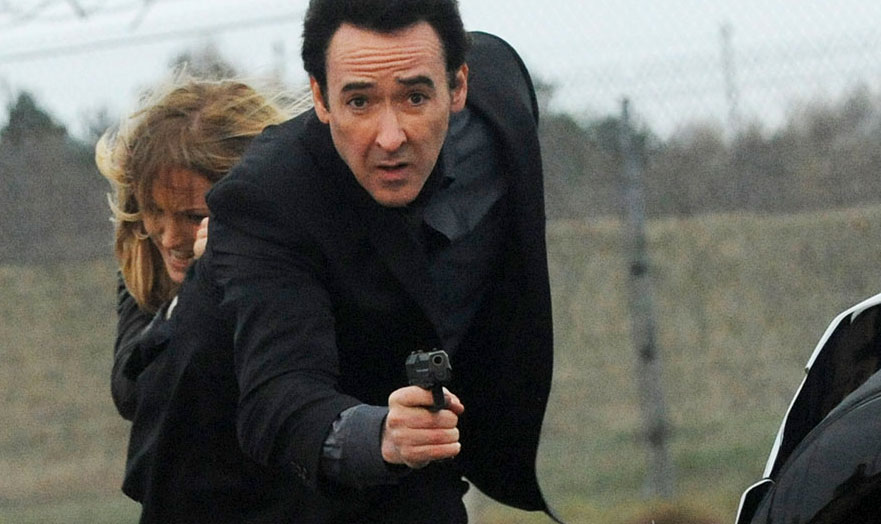
The Numbers Station follows a black ops agent, Emerson (John Cusack), along an almost cliched path of crisis of conscience that plays out oddly like a modernization of certain pulp crime novels. Seemingly content with his occupation, things come to a head when his normally routine missions suddenly result in some collateral damage. As is the norm in such stories, the fact that Emerson has any thought at all, much less something approaching outright defiance, means that his handler, Grey (Liam Cunningham), doesn’t think he’s up for the job anymore.
Emerson then finds himself taking over “security” for a numbers station, apparently the spy/assassin equivalent of riding a desk, until we can figure out if he’s going to “get his head right.” Said numbers stations are ultra-secret installations where code specialists, civilians who don’t know what they’re really doing, send out messages over short wave radio to operatives in the field. Thus, Emerson now has little to do but babysit Katherine (Malin Ackerman), his assigned specialist, and do a lot of thinking.
Clearly, nothing is going to actually be that simple, and before long the station has been compromised. Someone has infiltrated the station, and sent out a lot of numbers. It’s up to Emerson and Katherine to figure out what’s going on and what to do about it, all without any help able to show up any time soon. Just when Emerson thought he was more or less on vacation, he has a lot more on his plate than he knows how to deal with, and a lot more to think about.
A methodical dance that often focuses on lengthy, drawn out conversations, The Numbers Station is more tension than action, and relies almost exclusively on an ability to care where Cusack is mentally to garner investment. The themes and general morality play are too played out to deliver on their own, so its a question of character, and it’s a tricky one to answer. Cusack sells it well, and certain moments are worked to give us solid entry into the man behind the gun, but many viewers may not find enough to move us past the generality of the scenario.
The film’s entrance gives us an interesting scene as Emerson moves to take out an agent who abandoned the job, but the “downfall” is rather simplistic, and ultimately borders on unnecessary. That example gives us a good lead on the entire film, because the scene is actually a good one, and worth having, it just doesn’t connect to a solid layout of the plot construction.
That’s par for the course in this film that is somehow better than it is, because broken down into ten-minute segments, each of them are well-crafted, interesting, and provide some real tension, but fused together only amount to an average payoff. Though there are some clever twists, we never quite manage a momentum that would elevate the story as a whole.
Still, Cusack and Ackerman manage a chemistry that fits the purpose of the rather abnormal relationship they are thrown into, and the film’s flashback use is a testament to the fact that their is a good deal of creativity at play, even if it is lacking in more relevant areas.
The film’s real problem is that its “automatic outline” construction detracts from many of its positives. Had it moved outside the realm of “what obviously has to happen now,” the plot and pacing might have further buoyed solid performances, and its clear ability to create a sense of discomfort. Which is to say, it should have, and could have, been markedly better, which leaves you disappointed. It’s a special kind of negative for a film to send you away knowing it had more to do though, in the sense that it’s very nearly a positive.
In the end, though this is a movie that wants to provide a mystery and some chills, it is best when it provides an opportunity to walk with Emerson (his imagination scene is wonderful), much like all movies with almost no one in them, but it doesn’t give itself the chance to really deliver on those opportunities.
RU?

