
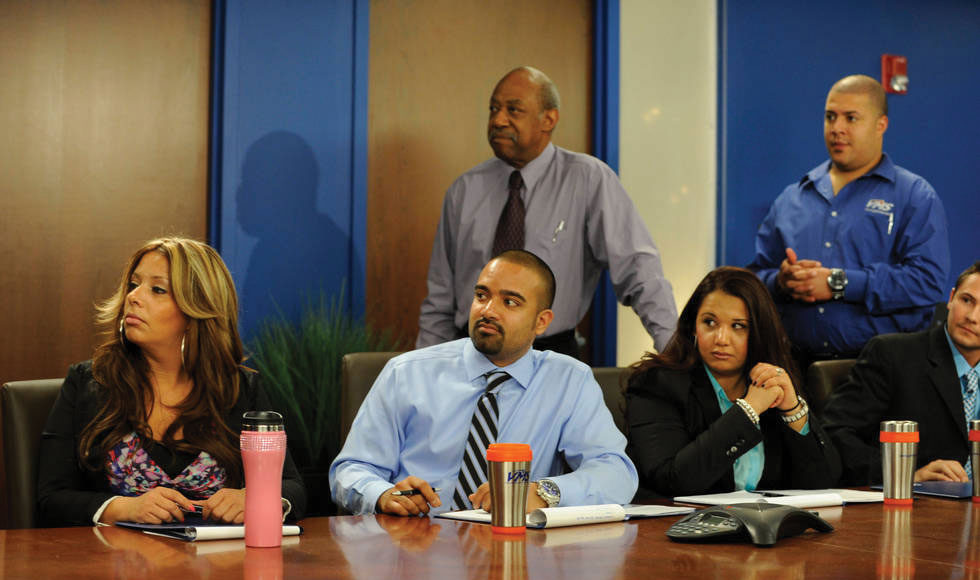
New FOX reality venture, Does Someone Have To Go turns the tables on bosses and employees in an effort… well, to bring you a bit of madness to quench your reality television longings. Now, you want to say that it’s in an effort to improve businesses in some fashion that we, at the very least, manage to pretend is behind such things as Kitchen Nightmares and Undercover Boss, but in this case the question mark is written in bold and prominently displayed.
The series kicks off with a two-parter which features Velocity Merchant Services (VMS), a smaller business with the usual employee problems. We’re introduced to the business by way of employees complaining about each other, and the fact that several family members of the owners work there. It’s typical stuff. Someone is lazy, talks to much, is arrogant and condescending, doesn’t pull their weight, or (you know how it is) is the mother of the boss, and therefore isn’t really held to the same standards.
The owners, theoretically, are looking for help with their business. Are they paying people too much? Do they have employees who are skating by and bringing the place down? Are certain employees causing so much friction that the entire office suffers? Generally, how do we need to improve?
In this spin on how our reality television comes into play, the owners leave the business for a couple of days, and put everything in their employees’ hands. Well, sort of. In this particular pair of episodes, this is an especially rough theory, because several employees are family, and they have to wade through whatever reality wackiness is in store for the rest of the employees.
Now, in general I’m something of a fan of this workplace reality genre. When you’re looking at something like Kitchen Nightmares, I’m largely on board. It may be a bit of an exploit, and you’re going to have to spice things up a bit sometimes, but if we can take reality television and actually help a few people out (as opposed to say finding a pack of idiots for the purpose of watching them be idiots), more power to you.
Does Someone Have To Go doesn’t manage to fit that bill. Most of the moves the show makes don’t actually make a lot of sense from the perspective of helping the company, and are designed more in the hope of starting a riot than kick-starting positive change for the workplace. Before anyone really has a handle on what’s going to happen, the staff is called into a meeting. The group views footage which has everyone talking about everyone else, and then they are presented with everyone’s salary. They thought they were talking semi-privately about their coworkers, but we’ve shown it to the entire staff, and now we all get to grumble about who makes how much. Sound fun?

Stranger still, the many legitimate complaints that these employees may have about the rest team don’t really seem to amount to anything. Oh sure, this person may not seem to get much of anything done, or another person making that much would probably do three times as much, but addressing these concerns (as opposed to simply sparking the turmoil inherent in sharing these thoughts with the group) isn’t exactly what we’re after.
Playing up the shtick of the show’s name, and adding a kind of sinister, game show twist to the affair, the employees then vote on which people should be fired, and then we look at who ended up in the bottom three of that vote. Everyone else is “safe,” and those three will have to defend themselves to the group before the owners return and are presented with… whatever, the results of our magical time here and whatnot.
Will someone have to go? I’m not sure it matters. Whether someone gets fired or not, the whole place is at a new level of chaos, and (it seems) we’re kicking the hell out of the drama hornet’s nest and taking off while you try to sort things out.
You have to allow for the idea that reality television shows aren’t really about judging them on some list of merits established for you. You aren’t deciding on your thoughts on plot, or the ability of the actors. Really, about the best possibilities you have are predicting whether people will watch, declaring that you hope people will watch, and some completely subjective “like.” Offered the chance to call the shots on Jersey Shore, for example, your predictions may not have gone the way you expected. It’s a similar boat here to be honest.
If you like watching the systematic creation of tension and drama so that you can watch the little puppets dance, this might be for you. Train wreck television at, potentially, its best. Whatever that statement might mean. Will it be popular? It’s a tough call, but I’m not sure if we’ve got exactly the right mix here, especially in this first episode.
But, do I hope people watch it?
Do you?
Does Someone Have To Go Promo
http://youtu.be/j-P61R58IjQ
On the new unscripted workplace experiment DOES SOMEONE HAVE TO GO?, the boardroom doors get blown wide open when employees are given the power to make some tough decisions. Frustrated bosses will hand over the reins of their companies to the employees, offering their respective staffs a chance to make changes in the workplace – even if it means letting co-workers go.
Almost every office across the country has some level of dysfunction, which often can be attributed to just a few select individuals – those co-workers who might be viewed as anything from lazy to incompetent to quite simply having a toxic personality that poisons the entire workplace. The difficult part for the employees is that, most of the time, the boss isn’t even aware of how bad the problem is, and the only person who can do anything about it IS the boss. That is, until now!
From Endemol USA (“Extreme Makeover: Home Edition,” “Steve Harvey,” “Wipeout”), DOES SOMEONE HAVE TO GO? will take viewers inside the workplace, as businesses including a sports product merchandiser, a credit card processing company and a home remodeling company make tough decisions to assure their long-term success. The unscripted series gives employees a voice in assessing how their company is functioning, inviting them to make recommendations on how best to solve their issues in order to make their company better and giving them the power to determine the fates of their fellow staffers. But when the owners leave their companies in the hands of their employees, those workers quickly learn that solving personnel issues isn’t as easy as it looks.
Each participating office will have its own set of issues, which will force employees to take a hard look at what’s plaguing their workplace and answer the toughest question of all: DOES SOMEONE HAVE TO GO?
RU?


