
Ender’s Game, as a film, has had me stumped for quite a while. That’s because, much as the book has become a classic of its genre, it’s basically a magic trick. It’s an impressive magic trick, but a magic trick nonetheless. One I know when I walk into the theater. Imagine something like The Sixth Sense, if you’d already read the book.
Worse, I never was sold on much the book had to offer by way of what is ultimately the patter, or the distraction that simply serves to build you up for the reveal. The majority of the story is interesting enough, and serves its role, but the trick is the only thing that makes the book. Not that there’s anything wrong with that, because it’s a great book, but it’s a different class of great book.
All of this means that I expect to go into a film so that I can sit through a lot of mediocre con game in order to be surprised by something I already know is coming. But, that isn’t what I got.
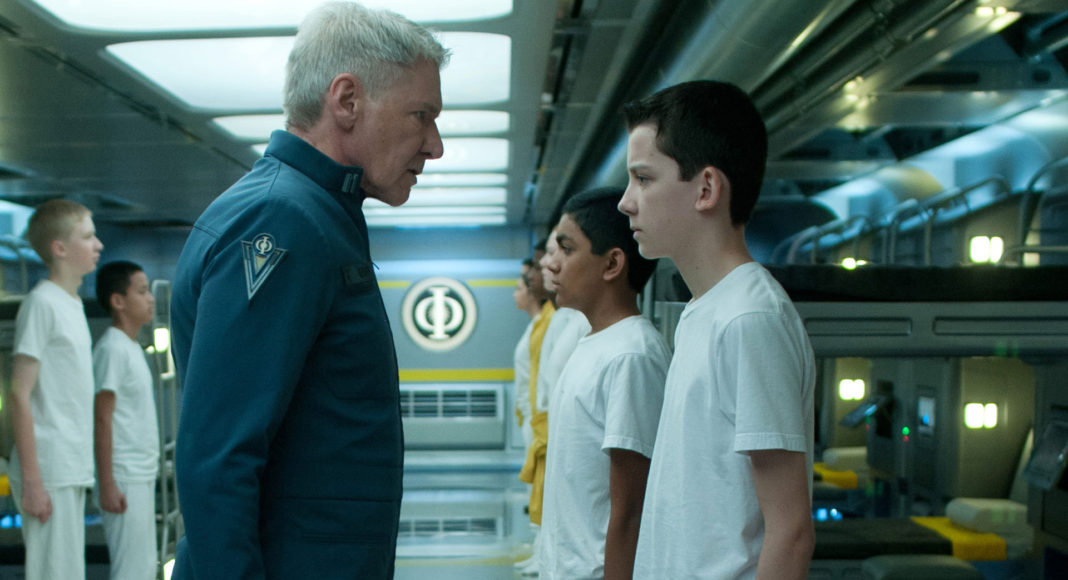
Asa Butterfield plays Ender Wiggin, a third child in a world where you better have a damn good reason if you think you’re going to have a third child. It’s also a world that was almost completely destroyed by alien invaders not that long ago, and the international military is desperate to avoid finding themselves in the same state of unpreparedness again. Young kids like Ender are recruited to prove their usefulness, strategic prowess, and mental ability, in the hopes of finding that special someone who will be able to defeat said aliens once and for all.
Harrison Ford is Colonel Graff, and we quickly learn that his job is not only finding the right candidates, but helping to create the right candidate. The potential superminds are brought on board so young, partially, because we can then put them through the right psychological-programming paces that will aid in the creation of the psyche that will get the job done.
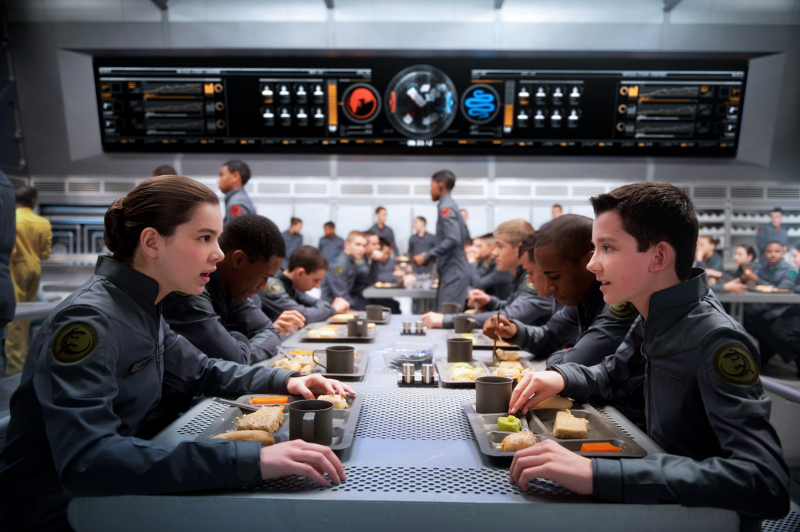
Ender not only has to deal with the fact that his military training is being maneuvered to put him through certain uncomfortable developments (such as being ostracized and directly bullied), but he has his own problems stemming from his family life. His older brother and sister both made it very far in the program, but brother Peter was far too quick to violence, and sister Valentine was, more or less, the opposite. Ender has had to grow up, not just with the knowledge that he is a living, breathing means to an end, but trying to figure out how to avoid being his siblings, while being mercilessly picked on by one of them.
As the film progresses, to a certain extent through developments too obvious and interactions too familiar, we get to Ender in a sense that is difficult for films to manage, and it’s all credit to Butterfield, who is amazing in the role. Ender is in a unique battle within himself as he marches along through the paces of his training, and while it has its analogy to deliver as well, selling the complexities of the smallest moments is something few actors of any age could have done as well. Ender’s personality (and he’ll spend the next books coming to grips with what he’s been turned into) isn’t just that of a genius who analyzes everything with a logic few can comprehend, but he is also removed almost from humanity in his own analysis.
In a scene which finds Ender in the shower being approached the bully he has one-upped too many times, Ender calculates during every second of the encounter, and he isn’t robotic (or perhaps Spock-like) about it, but cooly far more (or far less, depending on your philosophical stance) human as a rational entity. While the bully, and we can take this scene from dozens of teen-angst movies, is moving in with the aim of really beating this punk to a pulp, Ender is simply calculating the odds of survival and working out fourteen different ways to kill his opponent. He turns up the heat on the shower, and casually soaps himself up so that he’ll be slippery, and during the entire exchange, even after the fight starts, he might as well have simply been staring at a chessboard pondering the position.
That the film sells the depth of this scene, despite the somewhat caricature creation that is our bully, is a triumph on its own, and a prime example of everything the film does right. Unfortunately, director and screenwriter Gavin Hood has a slightly different agenda than Card did, which causes the film to try to move on to the rest of the series before it manages to properly work through its own efforts.
The family struggle is suggested, rather than delivered, leaving readers to bring the information with them, and the uninitiated to gather what they can from sloppily-textured cliche. Beyond that, there seems to be something this film doesn’t like its own trick, and the final reveal is given a very different tone and demeanor, almost as if it were somehow embarrassed about the power it manages, because of what that has to say about us as people. Which, frankly, is the whole reason anyone knows the book in the first place.
In the end, its a glorious construction in many ways, thoroughly entertaining for the most part, and yet it can’t quite deliver on its potential. So quick is it to rebound from the morality play it is, that it doesn’t quite become the morality play it is supposed to be. Curiously, that leaves an audience just slightly removed from the ability to connect in the way they should, but delivers an equally fascinating meta-statement on the collaborative entity that created the film, which is a little too Valentine and not enough Ender.
RU?


