
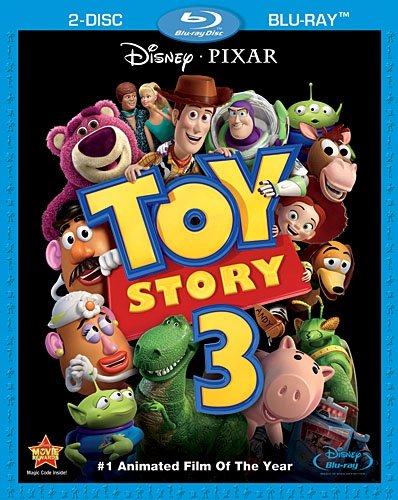
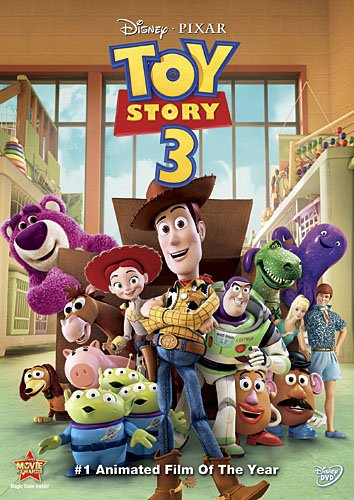
Toy Story 3 is out on Blu-Ray and DVD, and while I was not quite as taken with the film as most people, the home release exceeds even the standards we have come to expect from Pixar. The special feature effort is beyond just about anything else you’ll find, and more importantly, it is filled with interesting, quality bonuses.
The extras you get are really too numerous to mention, though I’ll try below, and the overall effort is amazing. Of course, when you’re the number one animated film ever, and can pretty safely predict that as an outcome, you can put a lot of resources behind more than just the film itself.
It’s likely that few people really need a lot of sell for this purchase, but below you can check out quite a bit to help you out, including – previews of the bonuses, an interview with Screenwriter Michael Arndt (during which I got a preview of one of the special features), and a lot more. Don’t miss the images and clips, and pick this one up as soon as you can.
Original Film Review
For filmmakers that are actually serious about their craft, third installments have a unique blend of difficulties. That’s why, when you weed out the nonsense and popcorn efforts, there really aren’t that many of them around. Pixar is unquestionably a studio that takes their fun seriously, but the trifecta is a treacherous hill to climb. Toy Story 3 is a fun film, and it’s sure to be a favorite among the younger crowd, but the majority of its power for anyone else is all too comparable to the sentiment Andy has looking through his toy box as he prepares to head off to college.
There is perhaps a strange mixture of Pixar‘s apparent effort to grow up (Up and Wall-E as prime examples), and this story’s focus on Andy doing just that. Eventually becoming almost sub-textually self-referential, we revisit old things in our chests with Andy, and while we may say things like, “Aww… Woody!” and reminisce about some great times, that doesn’t mean we want to play with them.
As mentioned above, the story kicks off with Andy getting ready to head off to college. He still has some of his favorite toys in his room, but now we’ve come to the moment of truth. Everything in his room is either leaving with him, going into the attic, getting donated to a daycare, or hitting the curb.
Woody makes it into the college box, but the rest are going into storage. Until they all wind up on the way to Sunnyside Day Care, of course. Despite Woody’s efforts to explain, the toys all think Andy meant to throw them away. Nevermind though, things look bright at Sunnyside. It’s been so long since they’ve been played with, that it all seems like a dream. Of course, dreams turn into nightmares, and we soon learn that Lotso (Ned Beatty) isn’t the friendly, strawberry-scented bundle of fluff he seems. It turns out that Sunnyside is a prison, and Lotso is the inmate running the joint. It may not sound so bad, but those toddlers can deal out the carnage when they want to.
Most of the elements are here, and all the new toys certainly add to the fun, but somewhere along the way a certain mentality of “good=serious” seems to have taken over this production. There are still fun moments, but the air of fun is missing. That isn’t surprising given the situation our toys find themselves in, but there is a strange level of intensity working its way through what we probably expected was another cute-ish adventure. Even allowing for the idea of a Toy Story prison break feature, it seems something a bit more Hogan’s Heroes and less The Great Escape might be in order.
Still, Pixar that isn’t quite up to par is still better than most things, but when you see an example of Deus ex machina popping up in your animated film (even if it is cleverly literal), you know things have gone a bit wrong. The reason the device exists is that you’ve written yourself into a corner to build up the drama or intensity to an almost absurd level, and you don’t really know why. It’s not quite what you expect from Pixar.
At the end of the film, we get a touching scene in which Andy actually plays with his toys. It comes together pretty well. You knew it would, but I wanted my chance as well, and the movie never delivered more than the flashback sequences it started with. I got to say, “Aww… Woody!” but I didn’t get to play with him.
Special Features-
There’s a full list of bonuses below, but I want to give some detail on some of the standouts. A full description of them all would take up an unbelievable amount of space, but you can get the idea of most of them.
Unfortunately, few of the best features are available outside the Blu-Ray, which is the growing trend. Toys! is a nice look at the development of the toys, and The Gang’s All Here provides fans with a lot of interesting footage of the voice talent, but overall these are not the showcase features.
The big effort is the Cine-Explore commentary by Director Lee Unkrich and Producer Darla K. Anderson. If you’re familiar with such features, this is a commentary with video wherein you get a very detailed rundown of the creation the film, and an in-depth look at many of the scenes. These bonuses, providing picture-in-picture and/or cutaways to video, are a growing trend, and really are the next step after standard commentary tracks. Here, you get a variety of behind-the-scenes looks, and this is probably the best such feature I’ve seen.
Where you will often get little beyond concept art, storyboards, and standard bonus features slapped into picture-in-picture mode, which frankly provides little additional value beyond cool factor, this one turns the viewing experience into something completely different. Almost a sort of creation presentation playing along with the film, there is clearly a lot of thought put into the creation of this bonus, and the result is far removed from the gimmicky efforts that have often come before.
The flow of things, and the additions that are included, make a lot more sense than you might be used to. There is a certain “realness” to how the effort comes about, and you can imagine sitting through the film with Unkrich, and when certain points come up, he says, “In fact, let me show you this.” And, then he does.
The game, Toy Story Trivia Dash, is worth mentioning just because it comes together much better than most such bonuses. A lot of family-oriented films take a shot at throwing in some game or other, even if there is little point, just because the DVD technology makes it possible. For the most part, these really are throwaway bonuses, and I’d be surprised to learn that they ever get use after the initial viewing of the disc. This one still isn’t quite the greatest thing in home entertainment, but it’s far beyond most. A trivia game covering all three films, it pulls from a wide range, and has a better interface than most.
You also get a story roundtable featurette which fans will love, and while it isn’t a particularly jazzy effort, it has a lot of meat to it. The director and story artists go over the creative process in a very casual run, with a lot of detail, and while it may not push the limits of technology, this intimate look at the minds behind the film is a solid bonus.
The rest speak for themselves mostly, and are of varying value depending on your personal tastes, but there is definitely a lot to choose from. The only drawback I can think of is that there might have been more available for younger crowds.
DVD :
Day & Night – The innovative and entertaining short from the imagination of Pixar artist and Director Teddy Newton.
Toys! – A closer look at all of Toy Story 3’s beloved toys from updating the classic characters to the creation of the Sunnyside Daycare and Bonnie’s Room toys.
Buzz Lightyear Mission Logs: The Science of Adventure – Produced in conjunction with NASA, this hybrid animation documentary of Buzz’s visit to the International Space Station focuses on research in zero gravity and Buzz’s triumphant return to Earth.
Paths to Pixar: Editorial – Pixar editors, past and future share anecdotes about their careers.
The Gang’s All Here – A touching look at the returning voice talent for Toy Story 3 and an introduction to the voices of the new characters.
A Toy’s Eye View: Creating A Whole New Land – A sneak peek at the new Toy Story-themed playland at Hong Kong Disneyland.
Studio Stories – A series of amusing animated anecdotes about life at Pixar.
“Where’s Gordon?” – An animator finds a hidden room at Pixar.
“Cereal Bar” – The majestic and expansive Pixar cereal bar is explored.
“Clean Start” – The Toy Story 3 animators shave their heads to mark the start of the film.
BLU-RAY COMBO PACK: Everything on the DVD plus…
Toy Story Trivia Dash – This cool game challenges you to sprint to the finish with Woody, Buzz, Jessie and Rex as you quickly answer questions about all three Toy Story movies.
Cine-Explore – Commentary by Director Lee Unkrich and Producer Darla K. Anderson.
Beyond the Toybox: An Alternative Commentary Track Featuring Leads from Story, Tech, Art and Animation – Commentary by Story Supervisor Jason Katz, Supervising Technical Director Guido Quaroni, Production Designer Bob Pauley and Supervising Animators Bobby Podesta and Michael Venturini.
Beginnings: Setting A Story In Motion – Screenwriter Michael Arndt analyzes successful opening scenes from Toy Story, Finding Nemo and The Incredibles.
Bonnie’s Playtime: A Story Roundtable – A roundtable discussion with Director Lee Unkrich and the story artists who brought the “Bonnie’s Playtime” scene to life.
Roundin’ Up A Western Opening – The development of the movie’s exciting opening scene.
Life Of A Shot – Toy Story 3 artists and technicians describe their contributions to a few of the shots in the film’s “Western Opening.”
Goodbye Andy – An exploration of character design, acting and animation in the scene “Andy’s Goodbye.”
Accidental Toymakers – By creating the Toy Story characters, the Pixar filmmakers found themselves in the unlikely role of toy designers. Meet the toy company that took a chance on manufacturing the now iconic toys and learn of their incredible success that began with a modest number of Woody and Buzz Lightyear toys 15 years ago.
Making of Day & Night – The story behind the unique 2D/3D blended short.
Own it on Blu-Ray and DVD Today!

Trailer
Michael Arndt Interview
Q – Was it very different writing Toy Story 3 compared to writing live action films?
A – Michael Arndt: In terms of writing characters or stories, at least initially, there’s no difference between live-action and animation. A good story is a good story, whatever the medium. It never occurred to me to “write down” for the animated characters — to me, Buzz Lightyear is just as real as Olive Hoover in Little Miss Sunshine. The big difference is in the re-writing process. In live-action, writing, production, and editing happen in discrete stages. In animation, they overlap — happening simultaneously. This allows a real dialogue to occur between the writer, the director, the actors, and the editor, and it makes the writing process a lot more collaborative and a lot less lonely.
Q – Was the director, Lee Unkrich, intimately involved with the writing of Toy Story 3?
A – Michael Arndt: Lee was down in the trenches with me every single day. Since he’s such a great editor and so familiar with the characters, I felt free to step on the gas and churn out pages and ideas as fast as possible, and trust that Lee would separate the wheat from the chaff. It ended up being a great collaboration.
Q – What was the biggest story challenge in the writing of Toy Story 3?
A – Michael Arndt: It may seem strange, but the hardest part of the script was actually the beginning — when you meet the Toys again after ten years have passed. We had to figure out what they’ve been doing for the last ten years, what their expectations for the future are, how they still feel about Andy… It took a long, long time and a lot of conversations to figure it all out. In fact, the scene where Woody calls his staff meeting — we called the sequence GROWN UP – was the one I re-wrote the most: I did 60 different versions of that scene before we settled on the final one.
Q – How do you keep the story pace going throughout the whole movie?
A – Michael Arndt: I have to credit Lee for keeping the story moving as briskly as he did. As a writer, you’re always tempted to throw an extra joke or two into each scene. Lee — who trained as an editor in film school — was absolutely ruthless in going through the script and weeding out anything that didn’t absolutely have to be there. So I’ll give credit to Lee.
Q – A lot of fans loved the fact that Totoro is in the movie. How did he come involved?
A – Michael Arndt: I remember sitting down to write the scene in Bonnie’s bedroom, and having to come up with who her toys might be. So I figured a little girl would have a unicorn, a triceratops, a hedgehog, and then — almost as a lark — I threw in a Totoro doll. I didn’t really think it would make it into the final film, but everyone here at Pixar is such a huge fan of Miyazaki that we decided to ask Studio Ghibli to let us put Totoro in the movie, and we’re all very honored that they said “Yes”.
Q – Can you talk about Lotso, one of the most important characters of this film?
A – Michael Arndt: I liked the idea of Lotso from the very beginning — he was a toy gone bad; who no longer believed in the love between a child and a toy. Like all good villains, his rather curdled view of the world makes sense in light of his experience. In a nutshell, Lotso got replaced by Daisy, and the lesson he drew was that everyone and everything is replaceable. When Ken stands up to Lotso at the end of the story, Lotso yells that there’s a hundred million Barbies just like the one he’s fallen for. Ken affirms that he loves Barbie — that she’s special and unique to him; that she’s not replaceable to him. To be pretentious for a second, that’s a gesture Shakespeare uses a lot — putting wisdom in the mouth of a fool.
Q – This wonderful bonus feature makes screenwriting sound so easy. But what’s the toughest part about writing a screenplay? Or does it vary from screenplay to screenplay?
A – Michael Arndt: Glad you liked the bonus feature. The hardest part of writing a script is deciding that you’re finished. With every other script I’ve written, I’ve always felt vaguely defeated by the whole process. Toy Story 3 was the first time I finished writing a script, and walked away feeling like it was really finished. That “finished” quality is one of the things I’m most proud of. (But it wasn’t easy.)
Q – You’ve said in earlier interviews that even comedies should be about something, or have values and take a stand. What do you view as the values or position that you were taking when writing “Toy Story 3”?
A – Michael Arndt: One of the biggest challenges of Toy Story 3 was figuring how the hero — Woody — would change over the course of the story. In the first Toy Story, Woody had to learn to share the spotlight with Buzz. In Toy Story 2, Woody faced and came to terms with his own mortality. For Toy Story 3, what we finally figured out was that Woody begins the story thinking that love means always being there for Andy. He’s similar to Lotso, in that he equates physical presence with the genuine expression of love, which is why he is so adamant in insisting that the Toys should “always be there” for Andy. It’s only at the very end, when he witnesses Andy and his Mom saying goodbye that Woody realizes you can love someone and still let them go, and that sometimes letting someone go can be the most loving thing a person can do. This is a universal experience — we all go through our lives getting to know people (childhood friends; high school sweethearts; college professors; work colleagues) that we can feel intensely connected to for part of our lives, but whom we have to let go of as we move through life. Recognizing this, and learning to accept it, is a fairly mature sentiment for Woody, and one that (to me, at least) nicely completes the arc of his character across all three movies.
Q – How much of your personal experience do you draw upon when writing a script?
A – Michael Arndt: You have to draw on everything you have as a person. That’s less about specific moments and experiences, and more about remembering specific feelings — especially those feelings that can seem private and particular. But my experience is that the more you can be truthful about those memories or feelings, the more other people will respond to them. The best writing really does come from the deepest, most private part of you.
RU?
Related articles
- DVD Review: “Toy Story 3″ (popdose.com)
- Toy Story 3 (Four-Disc Combo Pack) (cinemablend.com)

