
 There are two types of people in this world: those who like the works of William Shakespeare, and those who don’t.
Okay, that’s probably a bit over reductive, but if the world had to be reduced to some binary code, “Do you like the works of Shakespeare?” wouldn’t be a bad way to divvy up the 0’s and 1’s. And if the Zeros were “No’s”, and the Ones were “Yes’s”, I would be a proud card carrying member of the Zeros.
As heretical as it is in some quarters to regard the “Bard of Avon” as anything less than a God among men, I’ve never been a particular admirer of the legendary playwright. It’s not that Shakespeare was a talentless hack, there are a lot of things to admire in much of his work, but he is simply overrated as an artist (along the lines of Bruce Springsteen). It is undeniable that Shakespeare is an enormously important historical figure, and relative to his peers at the time, I’m sure Shakespeare was a revolutionary genius, but just because the Model T was a radical step forward in the history of the automobile, doesn’t mean I would want to drive one today.
The problem with Shakespeare’s work is that the humanity is far and few between. Shakespeare deals in large archetypes, characters who know exactly who they are from the day they’re born to the day they die, and even when his characters do experience moments of doubt, it is in such a grandiose and self-conscious manner that they have the wherewithal to pose such spiritually fastidious questions as, “To be or not to be?”. While I understand it is a slightly specious argument to expect creations of the late 16th/early 17th Century to have 21st Century Post-Modernist concerns of existential identity, it nevertheless remains hard for me to connect to characters who have the emotional nuance of a Hawaiian print shirt.
Reviewing Coriolanus as a film then is one of the more challenging assignments I have had here at Are You Screening? On the one hand, I’d like to be able to objectively analyze Coriolanus as a film and as an adaptation, putting aside to some extent my feelings towards the aspects of the Shakespearean play that bother me. On the other hand, the story is the story, the dialogue is the dialogue, and if you’re going to adapt one of Shakespeare’s plays, you’re going to have to take some knocks for weaknesses you brought along.
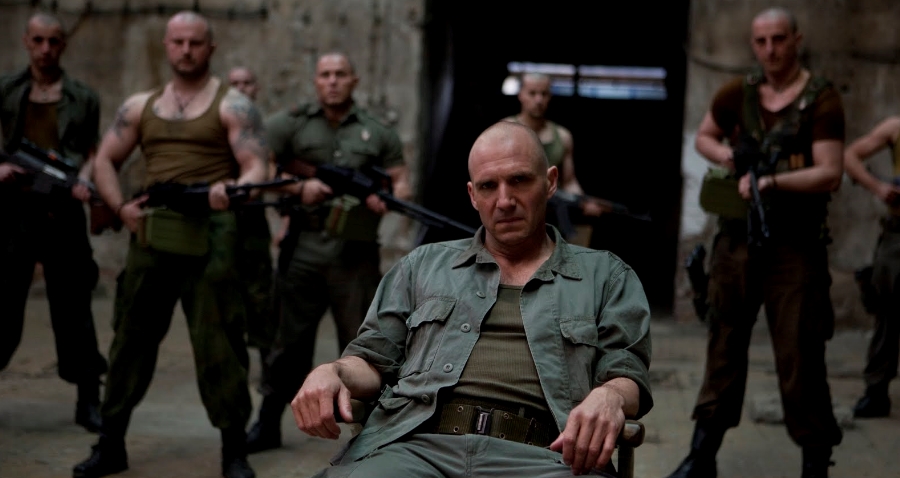
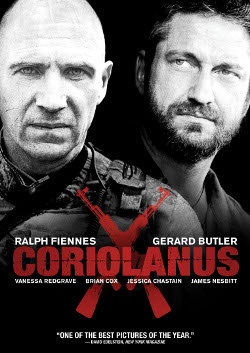
The story of Coriolanus centers around one Caius Martius Coriolanus (Ralph Fiennes), a proud soldier and warrior of “a place calling itself Rome” (it was actually Rome in the original play, but remains more vague in this modern setting). After bravely rallying his army and defeating the enemy Volscian forces, although failing to kill his arch-nemesis and leader of the Volscian army, Tullus Aufidius (Gerard Butler), Caius returns home a hero. Taking advantage of his new found popularity, and at the insistence of his lioness of a mother, Volumnia (Venessa Redgrave), and a slick patrician, Menius (Brian Cox), Caius decides, against his better judgement, to seek the office of consul.
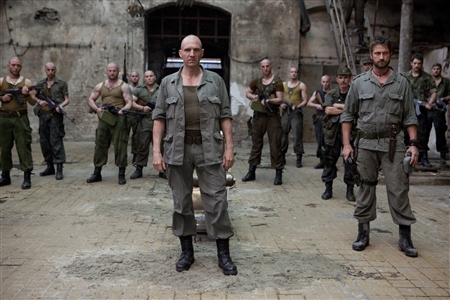
Initially receiving the support of both the senate and the commons, the citizens quickly backtrack after correctly sensing Caius’s unmeasurable loathing of the unwashed masses. Given one chance to repent and pledge his undying support for the popular rule of the plebeians, Caius only suppresses his uninhibited hatred of the commoners for the briefest of moments before unleashing a tirade against the very notion that one so outstanding as he should be restrained by the fickle desires of inferior slum dwellers.
This leads to Cauis’s immediate banishment from Rome. Spurned by the city he risked his life for and determined to see its citizens burn for their transgressions, Cauis does the unthinkable and joins forces with his mortal enemy, Tullus, in order to seek his revenge on the city that turned its back on him.
Coriolanus is one of Shakespeare’s lesser known plays, but the actual premise of the story is pretty strong. A man who gives his all for the protection and glory of his city, only to be betrayed by the citizens of that very city, is a rich setting for drama to grow. In a time where the virtue of democracy is almost axiomatic, it is also intriguing to see a story sympathize with a protagonist who is so fervently anti-democratic.
Despite these positives though, there is still the Shakespearean dialogue. While some find beauty in the sea of syllables that assault the ears during the lengthy soliloquies, I do not. I can’t help but think that any screenwriter today who filled his or her dialogue with so many tangential similes and analogies wouldn’t be given the time of day by any producer in the business (and rightfully so). The predictable, tragically ironic ending that Shakespeare employed again and again throughout his work, and does so here, is disappointing as well, as I would have preferred the narrative to have taken a darker, more Kubrick-ian route.
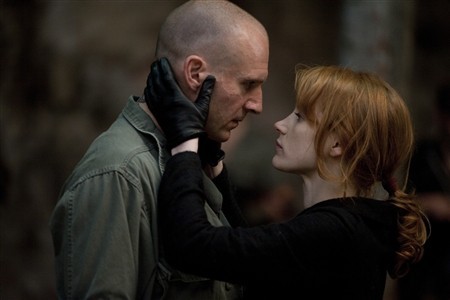
As a debut film though, actor/director Ralph Fiennes has a lot to be proud of. His decision to set the story amidst modern generic urban decay (provided aptly by the Eastern European countries of Serbia and Montenegro), is a mostly successful one. Unlike many actor-turned-directors who simply point the camera at the actors and let the story unfold (I’m looking at you George Clooney), Fiennes (with the help of cinematographer Barry Ackroyd) proves fearless and confident with the camera, having it voyeuristically bob and weave throughout the action sequences. The style has been done before, but even so, for a first-time director, I’m sure it took some courage.
Fiennes is without a doubt the film’s biggest asset, though not so much as a director, but as an actor. One of the biggest problems of any Shakespearean production is that the characters are so determined, and the language so flowery, that the actors tend to chew the scenery into cud. Unfortunately, that is the case with many of the performances in Coriolanus, but not with Fiennes.
His Cauis is a man of intense emotion, one who can not and will not articulate his feelings to others, for he views himself alone and apart from the people around him. The thing that makes Fiennes portrayal so impressive though, is that he does not relay these character traits so much in the dialogue, but in the simple glances and stares of silence (a lesson some of his fellow castmates would have benefited from).
In terms of special features, the DVD is fairly sparse. “The Making of Coriolanus” is a short (a little over five minutes) feature that is extremely shallow and consists of a few clips of actors describing their roles and what a pleasure it was to have Ralph Fiennes helming the movie. It most likely was a sort of publicity blurb to get Academy voters aware of the film, because that is definitely what it feels like.
There is also commentary from Ralph Fiennes as he guides the audience through the film and the reasons behind this and that decision. Fiennes does a good job narrating through the film, but I couldn’t help but think it might have been interesting to throw in one or two more voices into the mix, such as another cast member or maybe screenwriter John Logan.
Writing this review has been a schizophrenic experience. As a film, I admire a lot of aspects of Coriolanus. Ralph Fiennes’ passion for the project really comes through and his will alone almost makes this a good film. In the end though, my issues with Shakespeare prevent me from giving Coriolanus an unblemished recommendation. If you like Shakespeare, this is a must see, if you don’t, be ready to take the bad with the good.
RU?


