
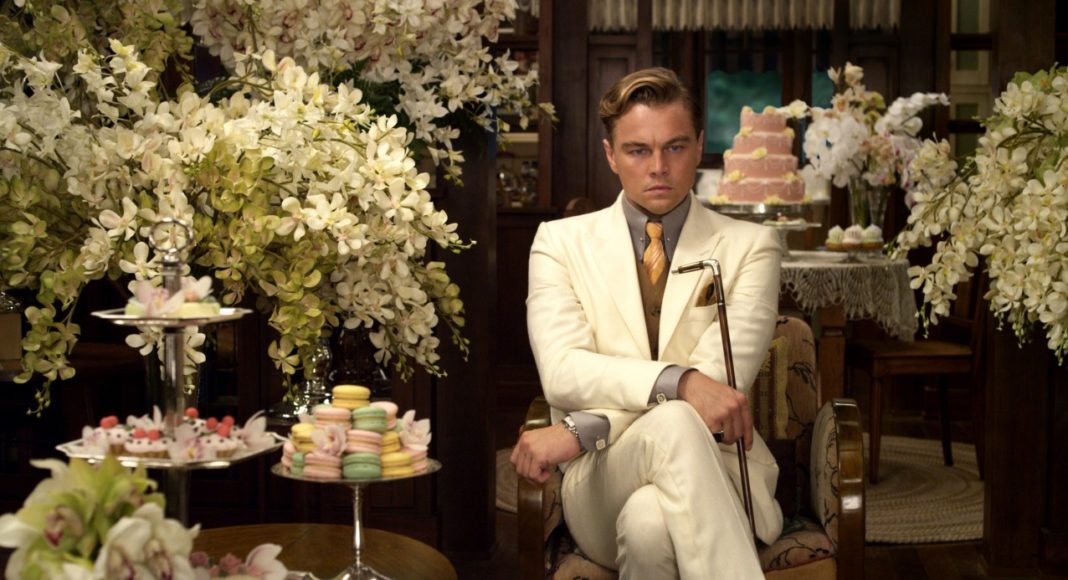
Taking on one of the best American novels ever is always going to make for a tough go, and when it’s The Great Gatsby, the uphill battle is all the worse. Condensing all that is most difficult to film into a brisk, layered prose that can be consumed in an afternoon, and analyzed for months, the book is mostly Nick Carraway’s thoughts on obsession, indulgence, and the odd nature of what we wish for. None of it is exactly well-suited for the screen, especially because the book gets its real power from Nick seeing it, not you.
As might be expected, Baz Luhrman has a somewhat different game in mind. The number of themes and metaphoric elements worked into the short page-count of The Great Gatsby is one of the most significant feats in all literature, nevermind just American novels, but whatever Fitzgerald might have been trying to say with his work, what got through to Luhrman is that there were outlandish parties. Almost managing some sort of self-referencing metaphor, Luhrman has captured the idea of these grandiose spectacles as a statement on the hollow, shallow nature of people, who hope simply to find something to mesmerize them, and the more meaningless the better; but he didn’t do it by creating the parties just so, or having the characters react to them in just the right way, but by making the film.
Luhrman’s Nick (Tobey Maguire), writing the story at us from a mental hospital after an apparent breakdown following his experiences in New York, manages the outside perspective fairly well, but delivers none of the depth required to pass along the themes, without which the story has nothing to offer. Where the movie is hollowed out and varnished with layer upon layer of flash and sparkle, as though the story were only ever interesting in some “reality television” sense, Nick is made the soulless spectator of same. He gives us the lines, such as that he is attracted and repulsed at the same time, but we have nothing upon which to base believing him. Similarly, though he tells us of his fondness for Gatsby, we have no way to make sense of it, except in the sense that audiences today are liable to understand, i.e. the inexplicable sense in which viewers refer to themselves as “fans” of people they love to hate on television.
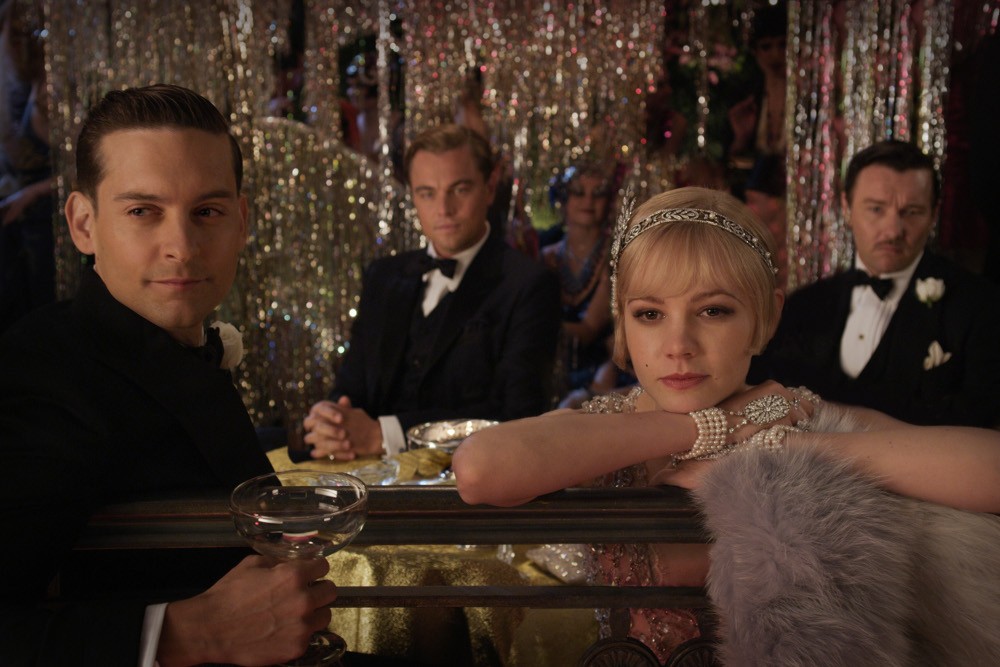
Nick talks about Gatsby’s obsession and incredible ability to hope, but if you believe this has anything to do with Nick’s attraction to Gatsby it is only because you bought it on the mere say so. The Nick we actually see is a kind of roadie hopeful, dazzled by the flash, and Gatsby’s cartoon-esque driving. Not that Nick isn’t meant to be a bit wet behind the ears, and awed by the grandeur of it all, but here he is almost lifeless, and though Maguire actually captures a certain charm that will hold onto you, he can only battle so valiantly against what he is given to do.
This may all stem from the fact that he is butting heads with Luhrman’s and DiCaprio‘s Gatsby, and meant to sell emotions that play at cross purposes to their intended object. At the end of the day, DiCaprio is miscast, but you can’t fault him for what he did here, which is, I have to imagine, to deliver what he was meant to with a perfection that is almost unheard of in film.
Through previous film incarnations of The Great Gatsby, the critical view has largely been the same. The point of the story is left on the floor for the sake of detailing the events with some great degree of accuracy. That, and the view that no one has really ever given us a Gatsby that came close to what the novel delivers. Redford came miles closer, but even he fell victim to a screenplay that wasn’t as obsessed with delivering theme as Fitzgerald was, and that one was written by Francis Ford Coppola.
Here Gatsby is very nearly parody of the character. His uncertainty and emotion bubble up at every turn, leaving him the least mysterious character to come along in ages. A man as hard to read as a billboard, and as suave and sophisticated as an especially shy schoolboy. Imagine DiCaprio’s role as Frank Abagnale Jr. in Catch Me If You Can, only with the added direction that no one should ever be fooled for a second. Gatsby, far from a man obsessed, and equally divorced from any connection to a statement on the American Dream gone wrong, is instead simply a kind of spoiled child who never grew up.
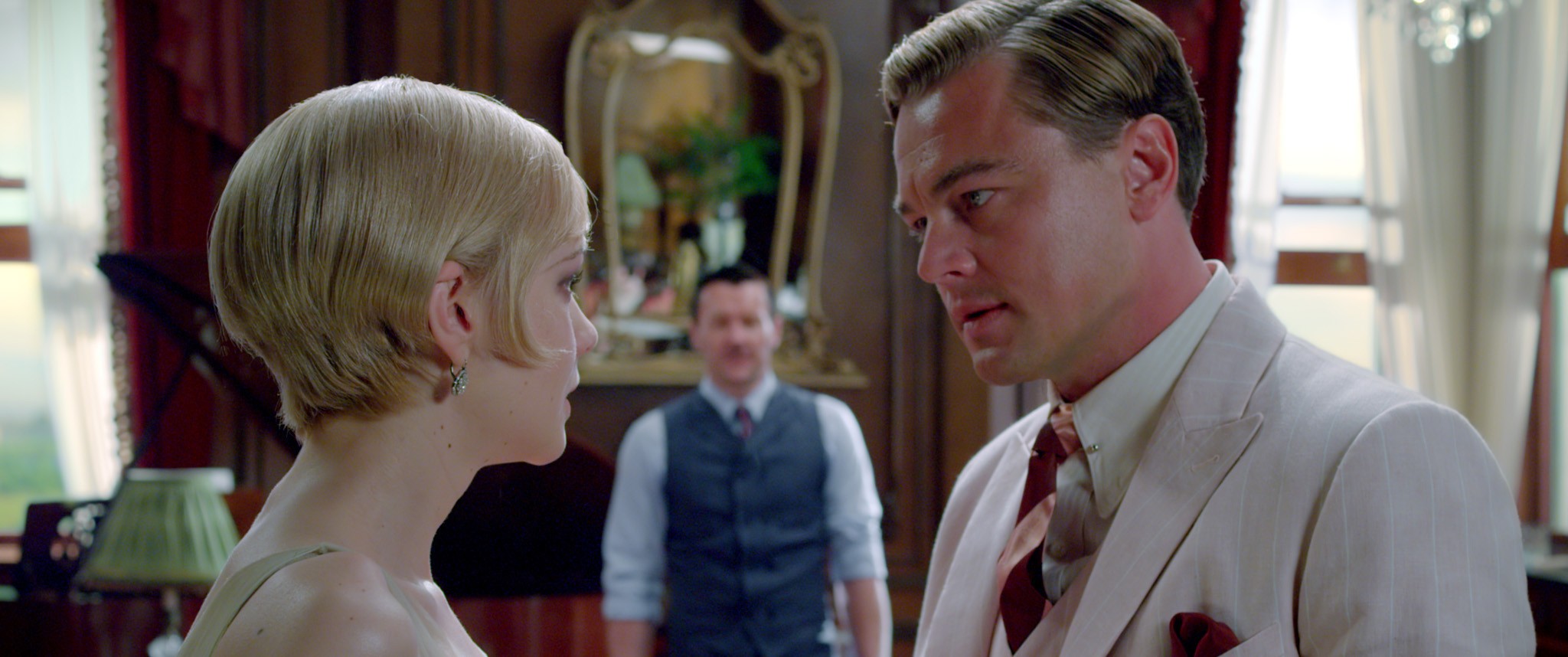
Tom Buchanan is equally caricaturized, put on show in the simplest terms, with all the accompanying value spelled out almost laughably. Rather than a workable representative of class distinction and antiquated ideals, he is simply as far as you can go minus the twirling of the mustache. So vacuous and despicable that when Daisy cannot say she never loved him, you can no longer take it seriously.
Thematic elements and motifs make their way into the film in much the same way. Dr. Eckleburg’s eyes show up frequently, and the green light could not be pointed to more obviously or more often. The shirt scene exists as well, along with many others. All of them are presented as though by someone with no idea why they exist in the book, but since they are, and we’ve heard people talk about them, we’d better stick them in. The shirt scene in particular, meant to convey the crush Daisy realizes when confronted with the idea that this is actually all for her, comes across as confused and meaningless. Another piece of a puzzle we don’t understand, or care to, there is no heart to the scene, and if it conveys anything, it is something like, “I don’t know, man. Chicks are weird. Sometimes they just cry.” Is she happy, sad, confused, buried under the symbolic weight of these ludicrously expensive shirts? There’s no way to tell.
Luhrman’s Gatsby certainly sparkles, and if your High School assignment calls for you to merely recount the events, you’ve got a fairly entertaining short cut available, but on any other level it is a failure. A layered, and impossibly brilliant confrontation of values and society, and a harsh look at the grim reality of the production of people apparently aspiring to the ultimate goal of having enough that they “win,” and thus get to do nothing, has all of its power and meaning wrung out of it. Made into farce, one suspects largely because it doesn’t think you have the ability to grasp the story if it told it, everything is exaggerated beyond sense to the extent that it seems sure that explanatory subtitles very nearly made the final cut. No longer capable of statement of any kind, it is instead become the product of the statements it is supposed to make.
RU?


